Facebook
 X
 Pinterest
 Copy Link
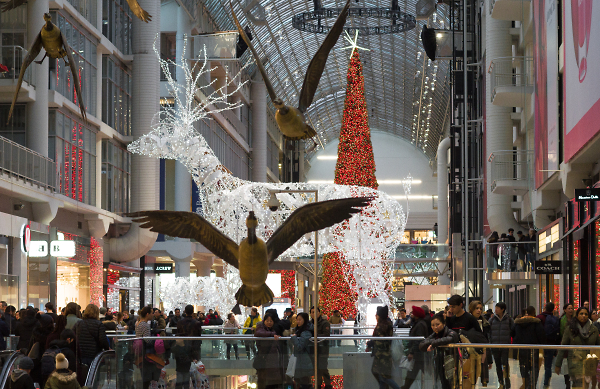
Look up in downtown Toronto, and a flock of geese is flying through a shopping mall — forever.
They are Flight Stop, Michael Snow’s 1979 sculpture of 60 fibreglass Canada geese suspended beneath the glass galleria of the Toronto Eaton Centre, at 220 Yonge Street. The galleria itself, modelled on Milan’s Galleria Vittorio Emanuele II, runs the full block from Queen Street West to Dundas Street West. When the first phase opened on February 10, 1977, it held 150 stores and a nine-storey Eaton’s flagship — the centrepiece of a $250-million project completed to Queen Street in 1979.
The name reaches much further back. Timothy Eaton, an immigrant from what is now Northern Ireland, founded Eaton’s in 1869 at 178 Yonge Street, a small dry-goods shop run on a then-unusual promise: fixed prices, no haggling and no credit. That shop grew into Canada’s largest department store chain, and Eaton’s came to own most of the land between Yonge, Queen, Bay and Dundas. The Eaton Centre was built on the ground where it all started.
Yet two neighbours were never Eaton’s to move. Old City Hall, finished in 1899, stood its ground at Queen and Bay. And tucked behind the mall in Trinity Square stands the Church of the Holy Trinity, consecrated on October 27, 1847 — built with a gift from Mary Lambert Swale of Settle, England, on one condition: its seats be free and unreserved forever. When the original Eaton Centre plans called for the church to be demolished, its parishioners resisted, the design changed, and Trinity Square Park was created instead. A small Gothic Revival church, older than Confederation, still sits in the middle of Canada’s busiest shopping district because ordinary people decided it mattered.
That is downtown at its best: commerce and conscience sharing one block, and a community willing to look after something — and someone — beyond itself. It is the part of this work I have always believed in, after some 35 years in Toronto real estate and 22 years as a licensed broker: honest guidance at hard moments, knowledge shared freely, and small, practical acts of help for the people around you. I have my own history in these halls, too. Eaton’s was one of my favourite stores — for years I did all my Christmas shopping there on Christmas Eve, racing the clock like half the city. The mall was where my friends and I hung out: drinks at Mr. Greenjeans, Edwin jeans from Rockwell’s on the corner where Sankofa Square — Dundas Square, as we all called it — stands now, and always some artist or musician performing somewhere in the galleria. We ate at Lime Ricky’s, and some nights ended clubbing at Mr Grumps across the street at the Atrium on Bay. So many memories live in this one block — and it is still my neighbourhood today: my own condo is a five-minute walk from these streets.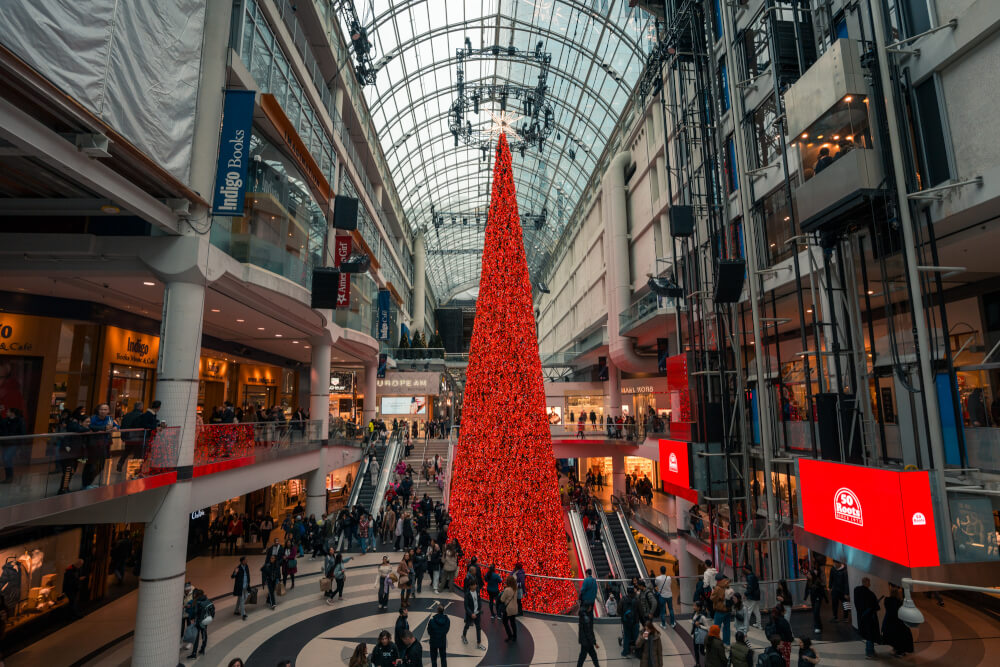
Eaton’s itself closed in 1999, but the centre kept its name, its geese and its job as downtown’s living room — sitting above two Line 1 stations, Queen and TMU, and woven into the PATH — the 30-kilometre underground city that Guinness World Records names the largest underground shopping complex in the world, some 4 million square feet of shops and walkways, and a network that began, fittingly, in 1900 with a single tunnel Eaton’s dug beneath James Street to link its main store to its annex. If you are thinking of buying, selling or leasing downtown — from Yonge and College to CityPlace and Navy Wharf — I would be glad to talk it through: call me at 416-543-4947, or book a time at ashchopra.net.
Ash Chopra
Real Estate Broker, Century 21 Leading Edge Realty Inc., Brokerage
1825 Markham Road, Suite 301, Toronto, Ontario M1B 4Z9
Direct: 416-543-4947 | Office: 416-298-6000
ashchopra.net
Photos: Pentax User gallery; Happy to Wander.
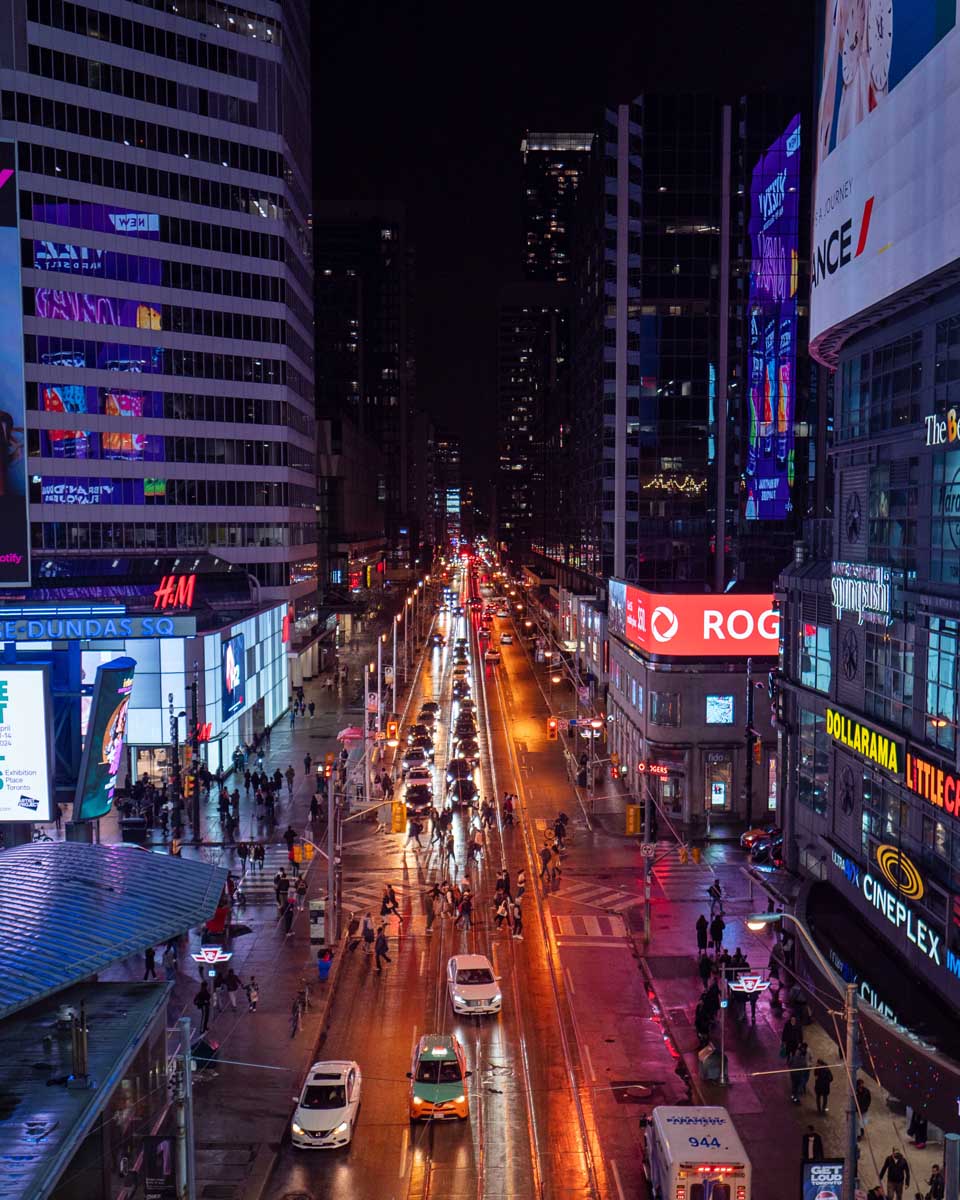
Living Here — Yonge, Queen to Dundas, Downtown Toronto
Schools and learning. Learning is woven into these blocks. Toronto Metropolitan University’s downtown campus surrounds the centre, and its Ted Rogers School of Management sits at 55 Dundas Street West, within the Eaton Centre complex itself. Younger students are served nearby by Church Street Junior Public School and Jarvis Collegiate Institute, east of Yonge, and by St. Michael’s Choir School on Bond Street.
Food and the local food scene. Inside the centre, the Urban Eatery on the lower level is one of downtown’s great group compromises — sushi, Thai, shawarma and burgers under one roof — while Eataly’s Eaton Centre location pairs an Italian marketplace with La Pizza & La Pasta. Just outside, JOEY Eaton Centre and Jack Astor’s handle sit-down meals, and Queen Street West and the streets around Sankofa Square (the square at Yonge and Dundas) fill in everything from quick ramen to late-night eats.
Paths, squares and green space. There is no waterfront on this block — the lake is a short walk or one subway ride south — but downtown gives you its own kind of open space: Trinity Square Park behind the centre, with its labyrinth, built with the Toronto Community Labyrinth Network and the City by 2005; Nathan Phillips Square at Queen and Bay, Toronto City Hall’s front yard; and the PATH, the underground pedestrian network that links the centre to the Financial District and Union Station through the worst of winter.
Places of worship. The Church of the Holy Trinity, at 19 Trinity Square, is the anchor: an Anglican parish consecrated in 1847, known since the Depression era for ministry to the city’s unemployed and homeless, and still an inner-city congregation today. A short walk east, St. Michael’s Cathedral Basilica stands at 65 Bond Street.
Community life and diversity. Few blocks in Canada hold this many lives at once: TMU students, office workers, condo residents, newcomers and visitors meeting under the geese, in Trinity Square, or at Sankofa Square across Yonge Street. Two subway stations — Queen at the south end and TMU at the north, both on Line 1 — plus the 501 Queen and 505 Dundas streetcars make it one of the most connected corners in the city, minutes north of Ash’s downtown listings at Aura, 386 Yonge Street, and the towers at Navy Wharf Court.